
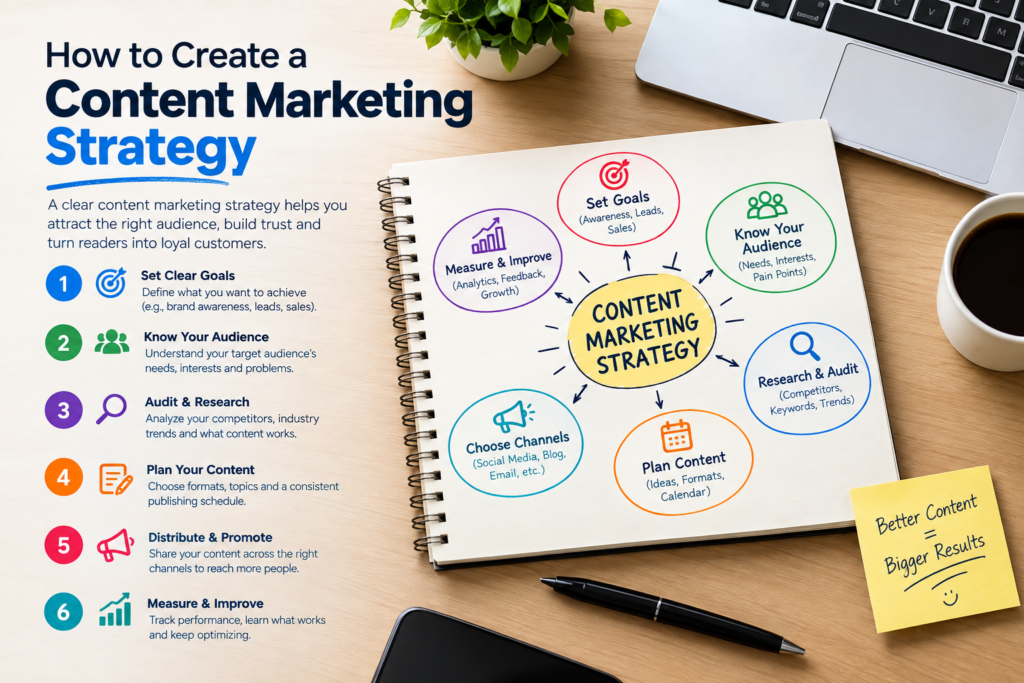
A strong online presence is essential for businesses that want to attract customers, build trust, and increase sales. One of the most effective ways to achieve these goals is through a well-planned content strategy. Instead of creating content randomly, businesses can use a clear strategy to reach the right audience with useful and relevant information.
A successful strategy helps businesses understand what type of content to create, who to create it for, where to publish it, and how to measure its performance. Whether you are a small business, startup, or large company, having a structured approach can make your digital marketing efforts more effective.
What Is a Content Strategy?
Is a plan that explains how a business will create, publish, distribute, and measure content to achieve specific marketing goals.
Content can include blog posts, videos, social media posts, infographics, email newsletters, case studies, and more. The main purpose is not simply to promote a product or service but to provide valuable information that helps the target audience.
For example, a digital marketing agency may publish blogs about SEO, social media marketing, Google Ads, and website development. This content can attract people searching for these topics and eventually turn them into potential customers.
Why Is a Content Strategy Important?
Without a proper plan, businesses may spend time creating content that does not reach the right audience. A well-designed content marketing strategy helps solve this problem by giving content creation a clear direction.
Some major benefits include:
– Increased website traffic
– Better brand awareness
– Improved search engine visibility
– More customer engagement
– Increased leads and conversions
– Stronger customer relationships
– Better brand credibility
Consistently publishing useful content can also help a business establish authority in its industry.
How to Create a Content Strategy
1. Define Your Marketing Goals
The first step in creating a successful content marketing strategy is identifying your goals. Ask yourself what you want your content to achieve.
Your goals could include increasing website traffic, generating leads, improving brand awareness, increasing online sales, or building a loyal audience.
Your goals should be specific and measurable. For example, instead of saying “I want more traffic,” you could set a goal to increase organic website traffic by 30% within six months.
2. Identify Your Target Audience
Understanding your target audience is one of the most important parts of a content strategy.
You need to know who your ideal customers are, what problems they have, what questions they ask, and what type of content they prefer.
You can create audience personas based on factors such as:
– Age
– Location
– Occupation
– Interests
– Buying behavior
– Problems and challenges
– Online platforms they use
When you understand your audience, it becomes easier to create content that connects with them.
3. Conduct Keyword Research
Keyword research helps you discover what people are searching for online. It is an important part of an SEO-focused content strategy.
Use keyword research tools to identify relevant keywords related to your products, services, and industry.
For example, a digital marketing business could target keywords such as “digital marketing services,” “SEO tips,” “social media marketing,” and “content marketing strategy.”
However, keywords should be used naturally. Avoid repeatedly adding the same keyword just to increase keyword density.
4. Analyze Your Competitors
Competitor research can provide useful ideas for your content strategy.
Look at the websites, blogs, social media pages, and videos created by your competitors. Identify the topics they cover and see which types of content receive the most engagement.
You should not simply copy their content. Instead, find opportunities to create content that is more useful, detailed, updated, or unique.
5. Choose the Right Content Types
Different audiences prefer different types of content. Therefore, your content strategy should include formats that match your audience’s interests.
Common content formats include:
– Blog posts
– YouTube videos
– Instagram Reels
– Infographics
– Podcasts
– Case studies
– E-books
– Email newsletters
– Social media posts
For example, a fashion brand may focus more on short-form videos and Instagram content, while a B2B software company may benefit more from blogs, case studies, and LinkedIn content.
6. Create a Content Calendar
A content calendar helps you organize your publishing schedule. It is an essential part of an effective content marketing strategy because it keeps your content consistent.
Your calendar can include:
Date| Topic| Content Type| Platform| Keyword
Monday| SEO Basics| Blog| Website| SEO
Wednesday| Marketing Tips| Reel| Instagram| Digital Marketing
Friday| SEO Mistakes| Blog| Website| SEO Tips
Planning content in advance reduces last-minute work and helps maintain consistency.
7. Create High-Quality Content
Creating content is not enough. Your content should provide real value to the audience.
A good content strategy focuses on quality rather than simply producing a large amount of content.
Before publishing, make sure your content is:
– Useful
– Accurate
– Easy to understand
– Original
– Well-structured
– Relevant to your audience
– Optimized for search engines
Use clear headings, short paragraphs, images, examples, and relevant internal links to improve the user experience.
8. Promote Your Content
Even high-quality content may not perform well if nobody sees it. Content promotion should therefore be included in your content marketing strategy.
You can promote your content through:
– Social media
– Email marketing
– Search engines
– Online communities
– Influencer collaborations
– Paid advertising
For example, after publishing a blog post, you can create multiple Instagram posts or short videos based on the same topic and direct users back to the full article.
9. Measure Content Performance
Tracking results helps you understand whether your content strategy is working.
Important metrics include:
– Website traffic
– Organic traffic
– Page views
– Engagement rate
– Time spent on page
– Social media shares
– Leads
– Conversions
– Click-through rate
Tools such as Google Analytics and Google Search Console can help businesses monitor website and search performance.
If a particular topic receives high traffic and engagement, you can create more content around that topic.
10. Improve Your Strategy Regularly
A content marketing strategy should not remain the same forever. Digital marketing trends, search behavior, and customer preferences continuously change.
Review your content performance regularly and identify what is working and what is not.
Update old articles, improve underperforming content, test new formats, and experiment with different topics. Continuous improvement can help your content achieve better long-term results.
Common Content Marketing Mistakes to Avoid
Businesses often make several mistakes when developing a content strategy.
Some common mistakes include:
– Creating content without clear goals
– Not understanding the target audience
– Overusing keywords
– Copying competitors
– Publishing inconsistently
– Focusing only on promotion
– Ignoring SEO
– Not measuring results
– Not updating old content
Avoiding these mistakes can make your content efforts more effective.
Conclusion
Creating a successful content marketing strategy requires planning, research, consistency, and continuous improvement. Businesses need to understand their audience, define clear goals, conduct keyword research, create valuable content, promote it across the right channels, and measure the results.
The goal should not simply be to publish more content. Instead, businesses should focus on creating useful content that solves problems and builds trust with their audience.
With the right content strategy, businesses can increase visibility, attract potential customers, strengthen their brand, and achieve long-term digital marketing growth.
How to Create a Content Marketing Strategy
A strong online presence is essential for businesses that want to attract customers, build trust, and increase sales. One of the most effective ways to achieve these goals is through a well-planned content strategy. Instead of creating content randomly, businesses can use a clear strategy to reach the right audience with useful and relevant information.
A successful strategy helps businesses understand what type of content to create, who to create it for, where to publish it, and how to measure its performance. Whether you are a small business, startup, or large company, having a structured approach can make your digital marketing efforts more effective.
What Is a Content Marketing Strategy?
A content strategy is a plan that explains how a business will create, publish, distribute, and measure content to achieve specific marketing goals.
Content can include blog posts, videos, social media posts, infographics, email newsletters, case studies, and more. The main purpose is not simply to promote a product or service but to provide valuable information that helps the target audience.
For example, a digital marketing agency may publish blogs about SEO, social media marketing, Google Ads, and website development. This content can attract people searching for these topics and eventually turn them into potential customers.
Why Is a Content Strategy Important?
Without a proper plan, businesses may spend time creating content that does not reach the right audience. A well-designed content strategy helps solve this problem by giving content creation a clear direction.
Some major benefits include:
– Increased website traffic
– Better brand awareness
– Improved search engine visibility
– More customer engagement
– Increased leads and conversions
– Stronger customer relationships
– Better brand credibility
Consistently publishing useful content can also help a business establish authority in its industry.
How to Create a Content Marketing Strategy
1. Define Your Marketing Goals
The first step in creating a successful content strategy is identifying your goals. Ask yourself what you want your content to achieve.
Your goals could include increasing website traffic, generating leads, improving brand awareness, increasing online sales, or building a loyal audience.
Your goals should be specific and measurable. For example, instead of saying “I want more traffic,” you could set a goal to increase organic website traffic by 30% within six months.
2. Identify Your Target Audience
Understanding your target audience is one of the most important parts of a content strategy.
You need to know who your ideal customers are, what problems they have, what questions they ask, and what type of content they prefer.
You can create audience personas based on factors such as:
– Age
– Location
– Occupation
– Interests
– Buying behavior
– Problems and challenges
– Online platforms they use
When you understand your audience, it becomes easier to create content that connects with them.
3. Conduct Keyword Research
Keyword research helps you discover what people are searching for online. It is an important part of an SEO-focused content strategy.
Use keyword research tools to identify relevant keywords related to your products, services, and industry.
For example, a digital marketing business could target keywords such as “digital marketing services,” “SEO tips,” “social media marketing,” and “content marketing strategy.”
However, keywords should be used naturally. Avoid repeatedly adding the same keyword just to increase keyword density.
4. Analyze Your Competitors
Competitor research can provide useful ideas for your content strategy.
Look at the websites, blogs, social media pages, and videos created by your competitors. Identify the topics they cover and see which types of content receive the most engagement.
You should not simply copy their content. Instead, find opportunities to create content that is more useful, detailed, updated, or unique.
5. Choose the Right Content Types
Different audiences prefer different types of content. Therefore, your content strategy should include formats that match your audience’s interests.
Common content formats include:
– Blog posts
– YouTube videos
– Instagram Reels
– Infographics
– Podcasts
– Case studies
– E-books
– Email newsletters
– Social media posts
For example, a fashion brand may focus more on short-form videos and Instagram content, while a B2B software company may benefit more from blogs, case studies, and LinkedIn content.
6. Create a Content Calendar
A content calendar helps you organize your publishing schedule. It is an essential part of an effective content strategy because it keeps your content consistent.
Your calendar can include:
Date| Topic| Content Type| Platform| Keyword
Monday| SEO Basics| Blog| Website| SEO
Wednesday| Marketing Tips| Reel| Instagram| Digital Marketing
Friday| SEO Mistakes| Blog| Website| SEO Tips
Planning content in advance reduces last-minute work and helps maintain consistency.
7. Create High-Quality Content
Creating content is not enough. Your content should provide real value to the audience.
A good content marketing strategy focuses on quality rather than simply producing a large amount of content.
Before publishing, make sure your content is:
– Useful
– Accurate
– Easy to understand
– Original
– Well-structured
– Relevant to your audience
– Optimized for search engines
Use clear headings, short paragraphs, images, examples, and relevant internal links to improve the user experience.
8. Promote Your Content
Even high-quality content may not perform well if nobody sees it. Content promotion should therefore be included in your content strategy.
You can promote your content through:
– Social media
– Email marketing
– Search engines
– Online communities
– Influencer collaborations
– Paid advertising
For example, after publishing a blog post, you can create multiple Instagram posts or short videos based on the same topic and direct users back to the full article.
9. Measure Content Performance
Tracking results helps you understand whether your content marketing strategy is working.
Important metrics include:
– Website traffic
– Organic traffic
– Page views
– Engagement rate
– Time spent on page
– Social media shares
– Leads
– Conversions
– Click-through rate
Tools such as Google Analytics and Google Search Console can help businesses monitor website and search performance.
If a particular topic receives high traffic and engagement, you can create more content around that topic.
10. Improve Your Strategy Regularly
A content strategy should not remain the same forever. Digital marketing trends, search behavior, and customer preferences continuously change.
Review your content performance regularly and identify what is working and what is not.
Update old articles, improve underperforming content, test new formats, and experiment with different topics. Continuous improvement can help your content achieve better long-term results.
Common Content Marketing Mistakes to Avoid
Businesses often make several mistakes when developing a content marketing strategy.
Some common mistakes include:
– Creating content without clear goals
– Not understanding the target audience
– Overusing keywords
– Copying competitors
– Publishing inconsistently
– Focusing only on promotion
– Ignoring SEO
– Not measuring results
– Not updating old content
Avoiding these mistakes can make your content efforts more effective.
Conclusion
Creating a successful content marketing strategy requires planning, research, consistency, and continuous improvement. Businesses need to understand their audience, define clear goals, conduct keyword research, create valuable content, promote it across the right channels, and measure the results.
The goal should not simply be to publish more content. Instead, businesses should focus on creating useful content that solves problems and builds trust with their audience.
With the right content strategy, businesses can increase visibility, attract potential customers, strengthen their brand, and achieve long-term digital marketing growth.